Iron-based Superconductors Exhibit S-wave Symmetry
Condensed-matter physicists the world over are in hot pursuit of a comprehensive understanding of high-temperature superconductivity, not just for its technological benefits but for the clues it holds to strongly correlated electron systems.
By Lori Ann White
Condensed-matter physicists the world over are in hot pursuit of a comprehensive understanding of high-temperature superconductivity, not just for its technological benefits but for the clues it holds to strongly correlated electron systems.
One important avenue of investigation is pairing symmetry. It’s a property of Cooper pairs, the bound electron pairs that are a hallmark of all superconductors, whether high-temperature or conventional. The paired electrons act as if they were a single particle, and the energy required to break Cooper pairs is measured by the superconducting gap. The symmetry of the superconducting gap, known as the pairing symmetry, is an important characteristic of Cooper pairs that is intimately related to the mechanism of superconductivity.
In conventional superconductors, the Cooper pairs have s-wave pairing symmetry, which takes the shape of a sphere. In contrast, Cooper pairs in the cuprate family of high-temperature superconductors exhibit d-wave pairing symmetry, which looks a bit like a four-leaf clover. The leaves, or lobes, are areas where the superconducting gap is finite. At the points where two leaves join, known as nodes, the superconducting gap goes to zero.
However, iron-based superconductors do not fall nicely into either of these two categories. Some members of this group exhibit characteristics of superconducting gaps with s-wave pairing symmetry, while others show signatures of nodes where the gap becomes zero, as with d-wave pairing symmetry.
The key to resolving this discrepancy remained unknown until recently, when a team of scientists from Fudan University used an instrument at the Stanford Synchrotron Radiation Lightsource's Beam Line 5-4 to measure the detailed superconducting gap structure of the ferropnictide superconductor BaFe2(As0.7P0.3)2. They discovered a signature that could not have originated from a d-wave pairing – a striking difference from the cuprate family.
This finding, the first measurement of its kind, provides solid experimental evidence that iron-based superconductors fall into the regime of s-wave pairing symmetry seen in conventional superconductors, and suggests that both nodal and nodeless gaps could arise from the same mechanism. This could lead to a unified theoretical framework for both phenomena, making the research an important step toward unveiling the mechanism of iron-based superconductivity.
Contact
For questions or comments, contact the SLAC Office of Communications at communications@slac.stanford.edu.
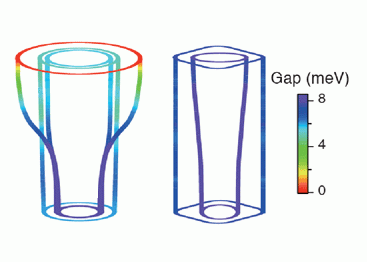
(Image courtesy D.L. Feng, et al.)